Front of the house, guarding against evil spirits, stone lion carving - male lion

Front of the house, guarding against evil spirits, stone lion carving - male lion

Front of the house, guarding against evil spirits, stone lion carving - female lion

Front of the house, guarding against evil spirits, stone lion carving - female lion

Chinese Taipei Dalongdong Stone Carving "Bao'an Palace Mother Stone Lion"

Chinese Taipei Dalongdong Stone Carving "Bao'an Palace Mother Stone Lion"

Since ancient times, China has been skilled in using bamboo strips to enrich and express depth and vitality through the interaction of "facial" bamboo strips. In traditional Chinese Han stone carving, this characteristic is most vividly reflected in the mid Qing Dynasty. Taking the stone lion with the inscription "Respected to Emperor Du Youzhang of the Qing Dynasty in the 14th year of the Jiaqing reign" as an example, its cheeks, nose wings, arms, shoulders, and limb trunks can all be seen with "tassels" dividing them, creating a turning point in the moving surface. The ribbon at the foot is also cut at the contour tassel, forming a bright and vigorous face, and conveying the layered and thick body feeling of the ribbon flipping. This pair of stone lions were punished for violating regulations by carving the female lion into an opening due to the craftsman's carelessness, resulting in no salary.
Stone Carving of the Northern Wei Vows Buddha Pagoda during the Northern Wei Dynasty in the 4th Century

Stone Carving of the Northern Wei Vows Buddha Pagoda during the Northern Wei Dynasty in the 4th Century

This Buddhist scripture pillar engraved with sacred Buddhist scriptures belongs to a group of miniature pagodas (scenic pagodas), which are only found in the Gansu Corridor in northwest China. Their age ranges from 426 AD to 36 AD, some of which bear the names of Buddhist donors who entrusted them at home. A pagoda is a circular building built to worship Buddhist relics. Miniature pagodas may be commemorating visits to holy sites or representing donations to religious groups and sites.
Lotus Terrace Thousand Hand Guanyin Stone Carving Sculpture
Lotus Terrace Thousand Hand Guanyin Stone Carving Sculpture

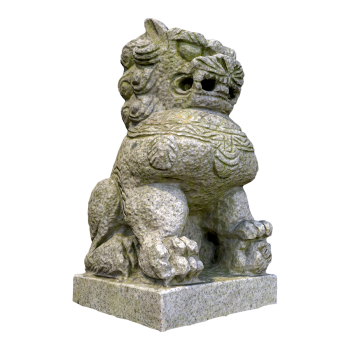
Stone lion

Stone lion

Common anti evil items in traditional Chinese culture. A sculpture of a lion made of stone as raw material, which has artistic and ornamental value. There is usually a pair of stone lions or bronze lions outside the gate, which are usually used to match with buildings for exorcism or decoration. The earliest surviving stone lion is the one in front of Gao Yi's tomb during the Eastern Han Dynasty.
Maitreya Buddha Stele

Maitreya Buddha Stele

This is an artwork created in 563 AD and is currently housed in the Minneapolis Museum of Art in the United States. Although this work is relatively small in scale, its exquisite carvings showcase the complete image found on larger Buddha statues. In addition to the Maitreya statue in the center, the engraved halo, and the bodhisattvas on both sides, flying heavens and dragons also appear on the flame shaped mandalas at the top and bottom. The back of the stone tablet is engraved with a 69 character inscription, which records the name of the donor who commissioned the production of this work and dedicated it in 563.
The stone carved Buddha statue on the pagoda is located in Kathmandu, Nepal

The stone carved Buddha statue on the pagoda is located in Kathmandu, Nepal

The four Buddha statues carved on the pagoda are located in a temple in the Swayambunat complex in Kathmandu, the capital of Nepal, and were built in the 16th century. The architectural complex of Swayambunat includes a pagoda, various temples and shrines, as well as Tibetan monasteries, museums, and libraries.
Panlong Pillar Stone Carving, located in Zhonghe Guangji Palace, Xinbei City, Taiwan, China, China

Panlong Pillar Stone Carving, located in Zhonghe Guangji Palace, Xinbei City, Taiwan, China, China

Shilongzhu is a traditional form of Chinese architecture that has been carved from natural stone throughout history. It is commonly used in ancient palaces, corridors, tombs, and other places. In modern times, it is often installed in squares, temple corridors, and ancestral halls to provide load-bearing and decorative effects. Due to the carving of dragon patterns on its pillars, it is called a stone dragon pillar or a stone carved coiled dragon pillar. The stone dragon pillar is usually carved from lapis lazuli, with a circular or square base, known as the Sumeru or Lotus Seat. The pillar is engraved with a coiled dragon rising and falling to look at each other, and decorated with auspicious cloud patterns. The bottom of the pillar is engraved with water patterns or mountains, symbolizing auspiciousness, wealth, and prosperity.
The statue of Gandhara Buddha Head from the fourth century Gandhara civilization

The statue of Gandhara Buddha Head from the fourth century Gandhara civilization

This Chinese cultural relic is a sculpture called "Gandarafo Head", which was created between 300-399 AD. This sculpture is currently housed in the National Museum of the Netherlands. The characteristics of this sculpture are the raised or bun on the head (ushnisha) and the raised point on the forehead (urna), which are standard features of Buddhism. The wavy hair combed back from the face is a characteristic of the Gandhara Buddha statue. In the early decades of the 1st century AD, the first batch of Buddha statues began to emerge. The dimensions of this sculpture are 24.0 centimeters high, 15.0 centimeters wide, and 11.8 centimeters deep.
Bodhidharma statue

Bodhidharma statue

Bodhidharma was a Buddhist monk who lived in the 5th or 6th century. Traditionally, he is considered the successor of Zen Buddhism to China and is regarded as the first patriarch of China. According to Chinese legend, he also began physical training for Shaolin monks, leading to the birth of Shaolin Kung Fu. In Japan, he is called Damo. Regarding the artistic depiction of Bodhidharma, he is depicted in Buddhist art as a non Chinese with a hot temper, thick beard, and wide eyes. He is referred to as' blue eyed Hu 'in Zen texts.
The Buddha Stele from the Eastern Wei Dynasty

The Buddha Stele from the Eastern Wei Dynasty

This stone monument is a cultural relic from the Eastern Wei Dynasty in China (534-550 AD) and is currently housed in the Cleveland Museum of Art in the United States. According to the inscription, this stone tablet was commissioned by King Yuanning of Gaoping in 537 AD to commemorate his deceased concubine, hoping that it could take her to the Western Paradise. Here, the Buddha's robe displays carefully arranged decorative patterns (large U-shaped folds and scallop shaped folds at the hem), combining linear rhythm and ordered symmetry. The mandala (almond shaped halo) on the edge of the flame echoes the linear eloquence of Chinese painting.
The stone lion statue in front of Datsan Gunzechounei in St. Petersburg, Russia

The stone lion statue in front of Datsan Gunzechounei in St. Petersburg, Russia

Datsan Gunzechounei is a large Buddhist temple in St. Petersburg, Russia, and also the northernmost Buddhist temple in Russia. The Chinese guardian lion in front of this temple is an important decorative and symbolic element. In Chinese culture, these stone lions are usually placed in front of important buildings such as palaces, official residences, temples, and cemeteries to symbolize power and status, and to protect buildings from evil and negative energy.
Statue of Gandhi and the Goat

Statue of Gandhi and the Goat

This sculpture is an exhibit located at the Gandhi Museum in Delhi, India. This exhibit depicts a scene of Gandhi and a goat. Gandhi once swore not to consume milk and buffalo milk as a protest against animal abuse. But under the persuasion of his wife and doctor, he eventually agreed to drink goat milk.
Statue of Nike, Goddess of Victory

Statue of Nike, Goddess of Victory

Nike is the ancient Greek goddess of victory, the daughter of the giants Pallas and Styx. Nike symbolizes victory in any field, including art, music, war, and sports. In Greek art, Nike is often depicted as the flying goddess of victory. This sculpture is the most famous work of Greek sculptor Paionios (late 5th century BC). This statue was discovered in Olympia between 425 BC and 420 BC. Including the pillars, the height of the statue is 12 meters. The statue is now in the archaeological museum of Olympia, and the pedestal is still in place in Olympia.
Statue of Duke de Richelieu of France

Statue of Duke de Richelieu of France

Duke de Richelieu was a French nobleman, soldier, and politician. He served as the Prime Minister of France from 1815 to 1818 and from 1820 to 1821, successfully causing the Allied occupation forces to withdraw from France. Prior to this, he served as the governor of Odessa and was renowned for his progressive administrative management. This monument was built in memory of him in 1828 after his death. This statue is one of the most famous statues in Odessa and ranks 10th among the 294 attractions in Odessa. This monument is currently located at the top of the Potemkin Steps in Odessa, Ukraine.
Saint George Dragon Slaying Sculpture

Saint George Dragon Slaying Sculpture

This sculpture is located in the courtyard of the Archbishop's Palace in Bratislava and is part of the Saint George Fountain. The Archbishop's Palace is a neoclassical palace located in the old town of Bratislava, the capital of Slovakia. This sculpture depicts the scene of Saint George riding a horse and fighting against a dragon. This depiction is based on a legend that emerged in the 12th century and was recorded in the medieval text collection 'Legenda aurea'.
Bratislava Angel Sculpture

Bratislava Angel Sculpture

This statue is in the image of an angel, holding a wreath and an inverted torch, with a skull on its pedestal. This statue is located in Gaistor Cemetery in Bratislava, a former Protestant cemetery that is now classified as an ancient building and was built in 1783.
Lammasu sculpture

Lammasu sculpture

Lammasu is a god in Mesopotamian mythology, typically depicted with the body of a bull or lion, wings of an eagle, and a human head. In art, Lammasu is depicted as a hybrid, a winged bull or lion with the head of a human male. This sculpture is located at the Pergamon Museum in Berlin. Lammasu's sculptures originated in the Sumerian period and later developed during the Asuro Akkadian period.
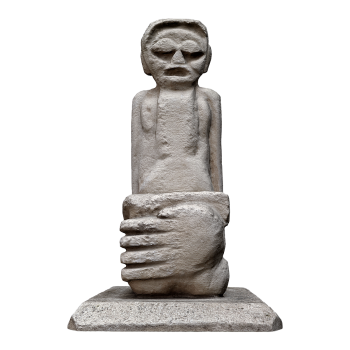
A humanoid sculpture in a clinic in Vienna

A humanoid sculpture in a clinic in Vienna

This sculpture is located in the Otaklin Clinic in Vienna's 16th arrondissement and depicts a seated humanoid figure.
Beijing Temple of Heaven Circular Hill Drainage Head Stone Carving

Beijing Temple of Heaven Circular Hill Drainage Head Stone Carving

Bali stone lion made of Indonesian marble
Bali stone lion made of Indonesian marble

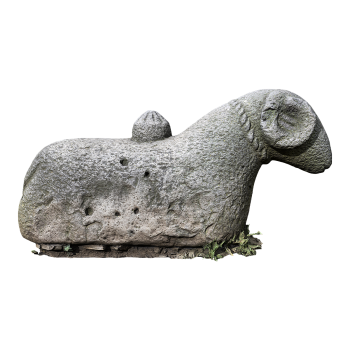
Stone carving of a ram at the Tbilisi Ethnographic Museum

Stone carving of a ram at the Tbilisi Ethnographic Museum

Stone Lion Stone Carved Pillar at the Gate

Stone Lion Stone Carved Pillar at the Gate